
New Research: Image Recreations of Visual Hallucinations (preprint)
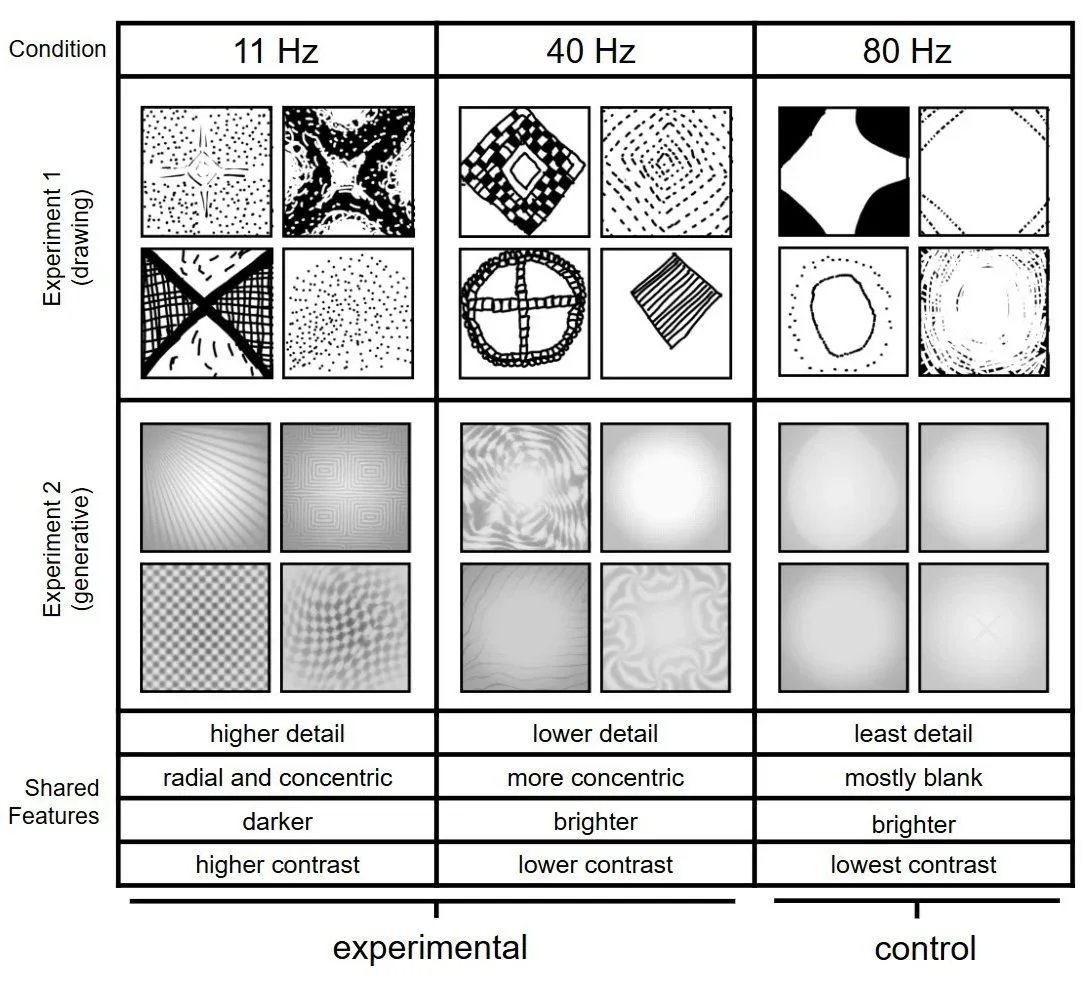
Figure 5 from the paper shows how typical hallucinations change at different frequencies of strobe light, with hallucinations resulting from 11 Hz light being the most intense.
We trained over 100 experimental participants to recreate images of their visual hallucinations. We just released a preprint which analyses what they saw.
We induced hallucinations using stroboscopic light.
We found that specific geometric properties of people’s visual hallucinations could be systematically altered by adjusting the frequency of the stroboscopic light (in other words, changing how fast the light flashes).
You can read the preprint now on PsyArXiv: https://osf.io/preprints/psyarxiv/2gtsy_v1
Trevor Hewitt, Ethan J Grove, Anil K Seth, David J Schwartzman (2026) Image Recreation Methods Enable Quantitative Characterization of Geometric Visual Hallucinations. PsyArXiv. doi: https://doi.org/10.31234/osf.io/2gtsy_v1